


Buying Real Estate With Your IRA: How It Actually Works

Real estate is one of the most popular alternative assets held inside retirement accounts, and for good reason — a lot of investors already understand rental property far better than they understand mutual funds. The concept isn't complicated, but it runs on a different rulebook than buying property in your own name. Get the fundamentals wrong and you risk more than a bad investment; you risk the tax-advantaged status of the account itself.
The One Rule Everything Else Builds On
When your IRA buys real estate, the IRA is the owner — not you. Not partially, not informally, not "for now until I transfer the title later." The account holds the property, collects the rent, and pays the bills. You direct the investment; you don't personally transact in it.
Wait — Can an IRA Even Own Real Estate?
Yes. Most people just haven't seen it before because their brokerage account doesn't offer it. A "self-directed IRA" isn't a special type of account under the tax code — it's simply an IRA held with a custodian willing to let you invest beyond stocks, bonds, and mutual funds. The limitation you're used to isn't a tax rule; it's a menu restriction set by whichever brokerage happens to be holding your account.
Move the funds to a custodian that administers real estate, private companies, notes, and other alternative assets, and the range of what your retirement account can own opens up considerably.
How the Purchase Actually Happens: A Five-Step Process
1. Open and fund a self-directed IRA. You don't have to move your entire retirement balance. If you have $400,000 in a traditional brokerage IRA and want to deploy $150,000 into real estate, you can transfer just that portion into a self-directed IRA and leave the rest invested where it is. A same-type transfer (Traditional to Traditional, Roth to Roth) generally isn't a taxable event — you're just changing custodians for part of the balance.
2. Find the property yourself. A self-directed custodian holds and administers the asset — it doesn't recommend, vet, or sell you the investment. Evaluating comps, rental history, condition, zoning, insurance costs, and the track record of any sponsor involved is entirely on you. The custodian's job is confirming it can administratively hold the asset; it isn't confirming that the deal is a good one.
3. Put the contract in the IRA's name — from the start. The purchase agreement and eventual deed need to name the IRA as buyer (something like Custodian FBO [Your Name] IRA), not you personally with a plan to "assign it over" later. Signing personally with intent to transfer it to your IRA afterward can itself trigger a prohibited transaction. Get the account set up and funded before you're staring down a closing deadline.
4. Let the IRA pay every dollar of the deal. Earnest money, inspection costs, down payment, closing costs — all of it comes from the IRA, not your personal checking account with a plan to "get reimbursed later." This is the mistake that trips up even experienced real estate investors: they're used to fronting small deal costs personally and squaring up afterward. With an IRA transaction, the retirement account is the buyer in every sense, including at the register.
5. Close, and let the separation continue. Once the deed records in the IRA's name, the property belongs to the retirement account — permanently, for as long as it holds the asset. That same separation between you and the asset continues through every rent check, repair bill, and eventual sale.
After Closing: Who Handles the Rent and the Repairs?
Same rule, ongoing: income belongs to the IRA, expenses come from the IRA. A $5,000 roof repair gets paid from IRA funds. A $3,000 monthly rent check gets deposited back into the IRA — never your personal account.
There are generally three ways to administer this in practice:
Direct administration — the custodian pays and receives on your direction. Works fine for low-activity assets like raw land.
An independent property manager — collects rent, pays approved expenses, and forwards net cash flow to the IRA. Useful for a straightforward single rental.
An IRA-owned LLC (a "Checkbook IRA") — the IRA owns an LLC, the LLC owns the property, and the LLC runs its own checking account for day-to-day transactions without routing every payment through the custodian.
Which one fits depends on transaction volume. A vacant lot sitting untouched for years doesn't need the overhead of an LLC. A rental with monthly income, recurring repairs, and multiple vendors often benefits from one.
Can You Manage the Property Yourself?
You can direct the investment. You can't personally provide the labor.
You're free to source bids, choose a contractor, approve the scope of work, and authorize payment from the IRA. What you can't do is grab a paintbrush and do the between-tenant touch-up yourself instead of hiring someone. The line isn't about oversight — you can oversee all day — it's about physically performing services for an asset that belongs to your retirement account.
The Rules You Really Don't Want to Break: Prohibited Transactions
IRC § 4975 restricts dealings between your IRA and "disqualified persons" — which includes you, certain family members, and related entities. The goal is preventing your retirement account from becoming a backdoor way to benefit yourself today.
In practice, this means: your IRA can't buy a place for you to vacation in, can't buy property from you personally, can't be pledged as collateral for your personal debt, and you can't personally guarantee a loan the IRA takes out. Breaking these rules is serious — a prohibited transaction can disqualify the entire account and treat it as if it had been fully distributed, with the tax consequences that implies.
Yes, an IRA Can Use Leverage
You don't need enough cash in the account to buy the property outright. Because you (as a disqualified person) can't personally guarantee a loan on the IRA's behalf, financing has to be structured as a non-recourse loan — the lender's only recourse in default is the property itself, never you personally.
So a $300,000 property might be financed with $180,000 of IRA cash and a $120,000 non-recourse loan, all without you signing a personal guarantee.
The Catch: UDFI
Using debt inside an IRA introduces a wrinkle called unrelated debt-financed income (UDFI) under IRC § 514. When borrowed money helps buy income-producing property, the portion of income tied to that debt can become taxable to the account, even though it's inside a retirement wrapper. The actual math involves average acquisition debt, adjusted basis, and other moving parts — it's not as simple as "half the property was financed, so half the income is taxed." If the account generates enough of this income, a Form 990-T filing may be required. This is genuinely technical territory — loop in a CPA familiar with self-directed accounts before you lever up.
Should You Use an IRA/LLC?
An IRA doesn't need an LLC to buy real estate — but for the right investor, it adds real convenience. The structure looks like: IRA → LLC → Property. Your IRA invests cash into a newly formed LLC in exchange for membership interest (often 100%), you serve as an uncompensated manager, and the LLC opens its own checking account to handle rent and expenses directly.
This tends to earn its keep when you're managing multiple properties, frequent transactions, rehab projects, or auctions where funds need to move fast without waiting on custodian paperwork. It tends to be unnecessary overhead for a single, low-activity property that a property manager already handles cleanly.
One important caveat: the LLC doesn't rewrite the rules. Every prohibited-transaction restriction that applies to direct IRA ownership still applies here. You still can't occupy the property, still can't pay yourself a management fee, and still can't personally guarantee the LLC's debt. The LLC changes how the investment is administered — not what's permitted.
Investing Alongside Other People
Your IRA doesn't have to own 100% of a deal. Multiple retirement accounts, or unrelated investors, can co-invest — provided ownership percentages and the corresponding income/expense splits are documented cleanly. Co-investing alongside yourself personally, or another disqualified person, is where this gets genuinely risky and deserves a conversation with an attorney before you sign anything.
Not All Real Estate Strategies Are Taxed the Same
A rental held for the long term generally produces straightforward rental income and investment gain on sale — both benefiting from the account's normal tax treatment, aside from UDFI if debt is involved. An IRA that's repeatedly buying, rehabbing, and flipping property in a pattern that looks like an active business is a different story — that activity can generate unrelated business taxable income (UBIT). There's no bright-line number of flips per year that triggers this; it's a facts-and-circumstances call worth making before you start the strategy, not after the tax bill arrives.
Don't Leave the Account Cash-Poor
One of the most common — and avoidable — mistakes: pouring nearly every available dollar into the purchase price and leaving the IRA with no cushion. If the roof needs $15,000 of work six months later, or the property sits vacant for a stretch, that money still has to come from the IRA — not your personal account. Budget for operating reserves before you commit to the purchase price, not after the closing is done.
Don't Forget the Annual Valuation
Custodians are required to report a year-end fair market value for every asset in the account, and real estate doesn't come with a daily quoted price like a stock does. Be ready to supply a broker price opinion, comparative market analysis, or appraisal when your custodian's valuation procedures call for it — especially if you're planning an in-kind distribution or Roth conversion where the valuation has a direct tax consequence.
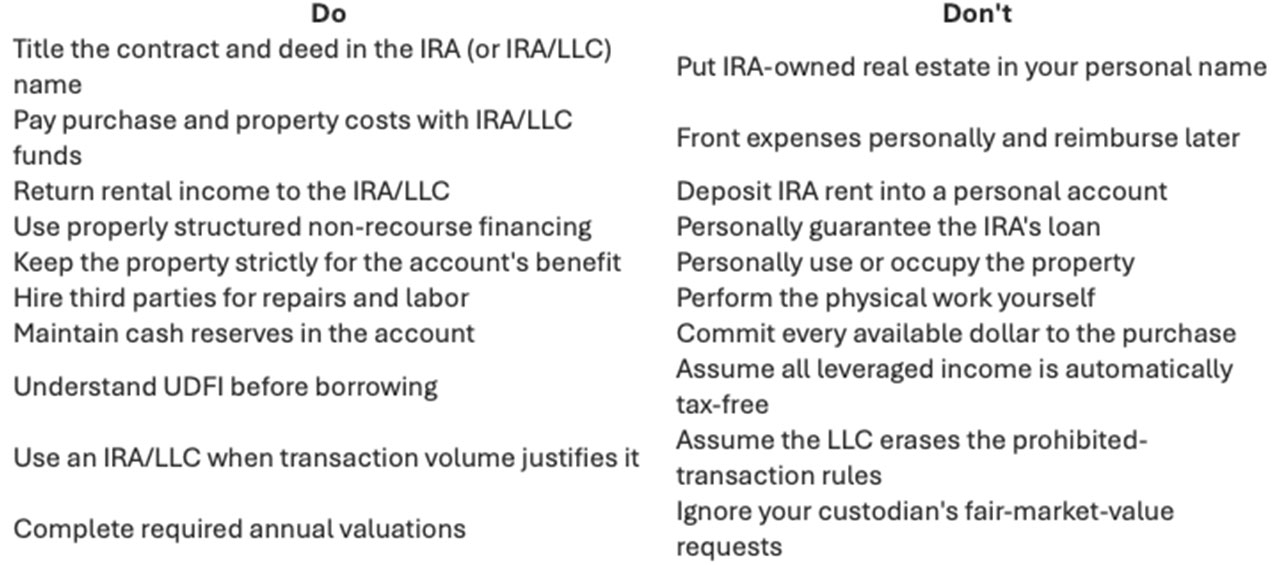
Quick Reference: Do This, Not That
The Bottom Line
Buying real estate inside an IRA lets you put retirement dollars into an asset class you may already understand better than the stock market — without losing the account's tax-deferred (or tax-free, for Roth) treatment. The mechanics are consistent throughout: the account owns the asset, receives the income, and pays the expenses, while you direct the investment and stay out of transactions involving yourself or other disqualified persons. Add leverage carefully, structure an LLC when the transaction volume actually calls for it, and keep enough cash on hand that a routine repair doesn't turn into a compliance problem. Handled this way, IRA-owned real estate can be a genuinely powerful piece of a retirement strategy — as long as the separation between "you" and "your IRA" never blurs.
This article is for general educational purposes and isn't investment, legal, or tax advice. Self-directed IRA transactions — especially those involving non-recourse financing, UDFI, UBIT, or related-party investments — depend heavily on your specific facts, so review your plans with a qualified tax or legal professional before proceeding.